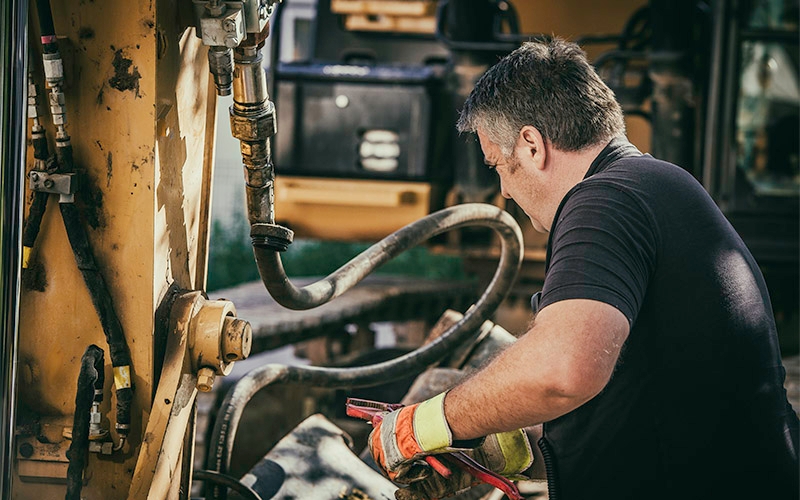
You wanted a job as a diesel tech, well, now you’ve got it. You’re all ecstatic with joy and congratulations to you on the new job, might I say. However, did you think about the right diesel tech tools for the job?
I started in this field with ZERO experience, and I am still new to it. I didn’t come into this completely blind though. I have always turned wrenches as a hobby and worked in the parts industry, automotive and heavy equipment, for almost 10 years total. Before that, I was a welder and fabricator. I know a thing or two about tools, especially PRICE.
You will be tempted by the tool trucks “no money up front” payment plan, but you can rack up debt VERY quickly (ask me how I know…). Your coworkers will also tempt you and pressure by showing off whatever it is they just bought and saying it’s the best thing ever but take what they say with a grain of salt. I’m writing this article for YOU, not THEM. I will give you my list of what I believe to be the most honestly affordable and best tools to start with if you’re starting from pretty much nothing, like me.
The Top 10 Tools Every Starting Diesel Tech Should Buy First
- Sockets & Wrenches (SAE & Metric)
- Ratchets & Electric Ratchets
- Impact Wrench (Air or Electric)
- Screwdrivers
- Pliers
- Pry Bars
- Hammers
- Diagnostic Equipment (Multimeter)
- Tap & Die Set
- Torque Wrench
#1 – Sockets & Wrenches
Without these, how can you even be a mechanic? These are the most basic and most necessary tools to acquire before even diving into electric or pneumatic tools. Every machine you work on of course has fasteners. To get the part you need to repair or replace, fasteners need to be removed. The only way to do that is with sockets and wrenches. I highly recommend buying a set of both standard (SAE) and metric (MM) sockets along with the same in wrenches. Just know, in the heavy equipment world, these fasteners can get big, which require a big socket or wrench.
#2 – Ratchets & Electric Ratchets
Ratchets are just as important as wrenches. For this type of work, I highly recommend a good 3/8-inch-drive ratchet long and short handle and a ½-inch-drive long and short handle to start. As time goes on, you will notice you need a certain ratchet for certain jobs. Some jobs require a super compact thumb ratchet whereas others will require the longest handle to get the most leverage to break a bolt loose. Tooth count is important too. In tight situations where you have obstructions and can only swing the ratchet so far, the finer tooth count can you get you more engagement and make life easier. Pass-through ratchets are very handy; however, I hardly ever use them. You will need it one day, and they’re inexpensive. Electric ratchets can turn a 5-minute job into a 5-second job. No more turning the bolt loose by hand, taking forever and tiring your arm and wrist out. That electric ratchet can also get into tight places and save you a lot of time, frustration and make you more productive.
#3 – Impact Wrench (Air & Electric)
Impact wrenches are most definitely necessary in this line of work. I come across so many stuck fasteners and impacts just break them loose with ease. A good 3/8-inch-drive and ½-inch-drive will do the trick to start. As you progress in your career, you might even need to invest in ¾-inch-drive and 1-inch-drive impacts. Counterweight bolts on excavators and hub bolts on haul trucks pretty much require it.
#4 – Screwdrivers
Screwdrivers go without saying anything. There are always crosshead or flathead screws on machinery. Sometimes little precision screwdrivers are necessary on electrical components.
#5 – Pliers
Every mechanic needs a good set of pliers, especially keeping a small pair in your pocket at all times. Sometimes it is just quicker to grab a pair of pliers than it is to grab the right socket or wrench. A good set of vice grips are essential too. There can be a lot of fabrication in this line of work, and they’re great for fabrication. Diagonal cutters are probably the pliers i use the most for electrical work, cutting zip ties and folding over cotter pins.
#6 – Pry Bars
You will need pry bars of all shapes and sizes. Believe it or not, the one I use the most is a small like 4-inch pocket pry bar. I use it every day, and I would consider it necessary. You will not be able to get tracks off a skid steer without a decent sized pry bar, such as my 6-foot pry bar. These can get pricey, but I know where you can get good quality ones at stupid low prices.
#7 – Hammers
The right hammers can make life easy. For starting out, if money is tight, you can get away with wood handles. I use fiberglass ones because they’re easier on my wrists. There are some super nice composite ones that are lightweight and don’t shock your joints as much. I do also recommend getting a 4, 6, 8 and a 12-pound sledgehammer. These will come in handy more than you think. For those big wheel seals or lip seals that you don’t have a driver tool for, get you a rubber mallet or a dead blow hammer. They’re cheap and well worth it and don’t mar whatever surface you’re working on.
#8 – Diagnostic Equipment
Don’t be alarmed by this one, I’m talking about basics for starting. A multimeter is a MUST. Make sure you also get a back-probe kit with all different probes that have different colors and different angles for back-probing into a wiring harness to chase that sneaky electrical gremlin. I also recommend getting some super long testing clamps. These usually come on a 25-foot roll; they’re little alligator clamps that hook on wires or whatever else you need to test. That’s really all you need to start with; all the other equipment I use is on my shop laptop and other tools for diagnostics are provided by my company.
#9 – Tap & Die Set
You will strip threads; it will happen. Get that into your head. To fix this, get you a tap and die set. Chase those threads, make them new again. Get the die out of the kit for your bolt and fix it too. Sometimes you even need to fabricate parts or tools to help with jobs, and some holes need to be tapped. Definitely a must have.
#10 – Torque Wrench
There are jobs that require the right torque spec to ensure the part is seated or installed properly. A torque wrench that’s half-inch drive, click-type and can go up to 300-foot-pounds is a pretty good start. Eventually you will need either an adapter than can read angles or a digital torque wrench that can read angle torque. A lot of these fasteners on these machines require X amount of torque then you turn the bolt 90 degrees.
Diesel Tech Tools You Should NOT Buy Yet
Do not go down the rabbit-hole and believe you need to start with absolutely every tool you come across. Here are some tools you can skip for now and acquire down the road:
*Specialty Pullers
*Scan Tools
*Relay testers
*Any sockets over 1-inch-drive
Starter Tool Budgets (Realistic)
I’m going to be honest, the starting budget isn’t super cheap, but it’s not like you need to take out a loan and finance your new home budget. Realistically you can start between the range of $2,000 – $2,500. You don’t need to buy the big fancy tool cart; you can get a big and decently sized one for around $800. You don’t have to buy name brand tools, go to Harbor Freight. I still do and will always use their tools. Don’t get yourself into life-changing debt to start a new job.